📞 24/7 free expert line: +90 216 888 15 46 — we're with you within seconds of an accident
Step-by-step guide
What to Do at the Scene of an Accident
In a material-damage accident, act in the right order without panicking. If anyone is injured, call 112 first; otherwise document the scene and start the licensed-adjuster report process.
The first and most important rule in any traffic accident is personal safety. If anyone is injured, call 112 immediately. An adjuster’s report is not drawn up in injury or fatal accidents; those situations are managed by authorised emergency, law-enforcement and medical teams. The steps below apply only to material-damage accidents with no injuries.
An accident always comes at a moment you least expect, and the decisions you make in the first few minutes are decisive for both your safety and your later claim. This guide walks you through exactly what to do, in a clear order: personal safety first, then protecting the scene, then documentation, and finally starting the licensed-adjuster report process. Follow the right order and you protect both yourself and your rights.
~45 sn
Çağrı yanıt süresi
7/24
Uzman hattı
81 il
Türkiye geneli
4.7/5
145 değerlendirme
What to do in the first 5 minutes at the scene
The first minutes are hectic, so prioritising matters. In order:
1. Check for injuries and personal safety
Check yourself and your passengers. At the slightest suspicion of injury, call 112 and do not move the injured person unless absolutely necessary. In an injury accident the priority lies entirely with the medical and law-enforcement teams; the adjuster report is only for material-damage accidents without injury.
2. Prevent a second collision
Switch on your hazard lights. Where possible, place the warning triangle at a sufficient distance behind the vehicle (roughly 30 m in town in daylight, further on motorways and at night). If you are at a busy spot and staying in the vehicle is dangerous, move to the safe side of the barrier.
3. Document before moving the vehicle
If the vehicles are not endangering traffic, leave them in place until you have finished documenting. The position is critical information for understanding the angle of impact and the fault.
Why documenting the scene correctly matters
An accident lasts only moments, but the claim process can take days or even weeks. That is why documenting the scene correctly is decisive in putting your file on firm ground. Photos taken from different angles without moving the vehicles, frames where the plates are clearly visible, and images showing road and weather conditions are the core data the adjuster relies on when forming the technical opinion.
For good documentation, pay attention to these:
Wide angle + close-up
First capture the overall position of both vehicles on the road in wide angle, then the damaged areas up close.
Plates and documents
Frames clearly showing both plates, plus the other party's registration, licence and traffic insurance policy.
Surroundings and conditions
Lane markings, traffic signs, lighting, weather and road surface (wet/icy) conditions.
Recording a short video with your phone is also valuable: pan 360 degrees around the surroundings so that details still photos miss are captured too.
Step by step: what to do at the scene
The order below helps you proceed without panicking. The mobile app and the 24/7 call centre are with you at every step. Our calls are answered in about 45 seconds; whether you start by phone or in the app, the expert team tells you the next step.
1
If anyone is injured, call 112
Injuries first dial 112; the adjuster's report is for material damage without injury.
2
Secure the scene
Move the vehicle aside, switch on hazard lights, place the warning triangle.
3
Document the scene
Take photos and video without moving the vehicles; plates and damage clearly visible.
4
Collect the other party's details
Driver, plate, registration, licence and policy details.
5
Open Alo Tutanak / call
Start the record in the app or call the 24/7 line.
6
The adjuster draws up the report
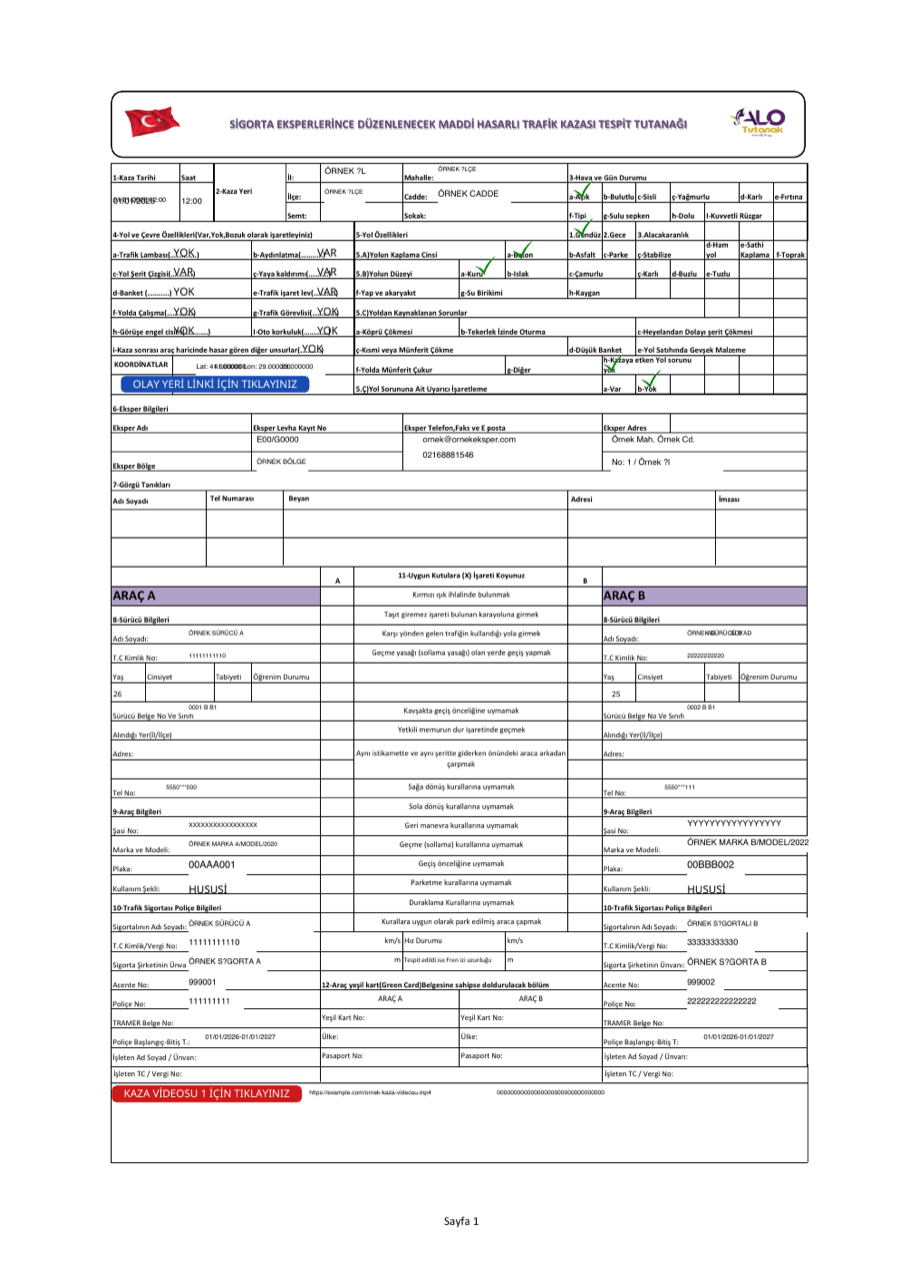
The authorised adjuster prepares the report with a technical opinion and sketch.
How the remote process works
Alo Tutanak’s biggest convenience is that the process runs remotely. You do not wait for the adjuster to physically attend the scene; you stay there, share the material, and the expert handles the rest.
You: Share photos, video and the location; pass on the other party’s details.
The expert team: Manages the process on the 24/7 line and asks immediately for any missing document or image.
The authorised registered insurance adjuster: Draws the sketch, forms the technical opinion, and prepares the report based on the data.
The result: Completed with a digital signature from both parties, the report becomes ready for the insurer’s claim file.
The licensed-adjuster difference
Unlike the simple mutual report drivers fill out themselves, the licensed-adjuster report is drawn up under Law 5684 art. 22/17 by an authorised registered insurance adjuster and may include a technical opinion and sketch. This helps keep your case strong even if the other driver denies the accident or the statements conflict.
It should also not be confused with the SBM Mobile Accident Report (ALO KTT) app that drivers fill in among themselves on their phones: that app relies on the drivers’ statements. Alo Tutanak, by contrast, supports the report process signed by an authorised registered insurance adjuster.
Safety and compliance note
The service supports a report process carried out under Insurance Law 5684 art. 22/17 by an authorised registered insurance adjuster. Your personal data is processed in compliance with KVKK (Law 6698). The app, call line and guidance are free; the adjuster fee process is handled under Law 5684 art. 22/19 and the relevant insurance contract terms. It is available across 81 provinces of Turkey, and the report has evidential value in the insurance process.
No. An adjuster's report is not drawn up in injury or fatal accidents. Call 112 first where emergency or law-enforcement response is required.
Even if statements conflict, as long as both parties take part and sign, the licensed-adjuster report can be drawn up and sets out a technical opinion through an impartial expert assessment. Unlike the simple mutual report drivers fill out themselves, this supports your file. If the other party refuses the process entirely and authorities are needed, call 112.
If it is safe and not obstructing traffic, leave the vehicles in place until you have documented them. If they endanger traffic, take photos/videos first, then move them aside.
The app, call centre and expert guidance are free. The adjuster fee process is handled under Law 5684 art. 22/19 and the relevant insurance contract terms.
Capture the overall position of the vehicles on the road (wide angle), frames clearly showing both plates, close-ups of the damaged areas, lane markings, traffic signs, and the weather/road conditions. If you can, record a short video of the surroundings. These images are the core data the adjuster relies on when forming the technical opinion.
No. Anyone can call the free 24/7 call centre; the expert team guides the process by phone. The other party does not need to have installed the app.
The process runs remotely. You stay at the scene and share photos, video and the location; based on this data, the authorised registered insurance adjuster prepares the report including a sketch and technical opinion. In most cases the file becomes insurer-ready without the adjuster needing to attend in person.